Filtration Media
swtwater.com Birm®
 
Request For Quote
Birm® (P/N LC10001) is an efficient and economical media for the reduction of dissolved iron and manganese compounds from raw water supplies. It may be used in either gravity fed or pressurized water treatment systems. Birm acts as an insoluble catalyst to enhance the reaction between dissolved oxygen and the iron compounds.
 
 
In ground waters, the dissolved iron is usually in the ferrous bicarbonate state due to the excess of free carbon dioxide and is not filterable. Birm, acting as a catalyst between the oxygen and the soluble iron compounds, enhances the oxidation reaction of Fe++ to Fe+++ and produces ferric hydroxide which precipitates and may be easily filtered.

The physical characteristics of Birm provide an excellent filter media which is easily cleaned by backwashing to remove the precipitant. Birm is not consumed in the iron removal operation and therefore offers a tremendous economic advantage over many other iron removal methods.
 
 
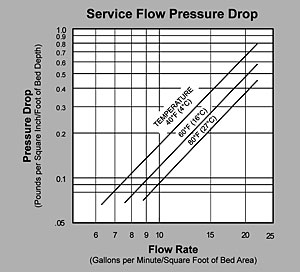
Birm Pressure Drop Graph
 
PRESSURE DROP — The graph above shows the expected pressure loss per foot of bed depth as a function of flow rate at various temperatures.
 
 
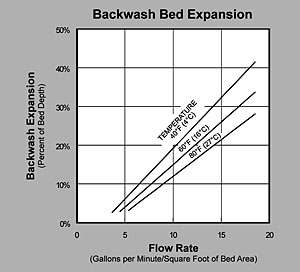
Birm Backwash Graph
 
BACKWASH — After each cycle the media bed should be backwashed at a rate that expands the bed 20 to 40 percent.


When using Birm for iron removal, it is necessary that the water: contain no oil or hydrogen sulfide, organic matter not to exceed 4 to 5 ppm, the dissolved oxygen content equal at least 15% of the iron content with a pH of 6.8 or more. If the influent water has a pH of less than 6.8, neutralizing additives such as SWT Neutralizing Medias (P/N PH10001 or P/N PH10003) or soda ash may be used prior to the Birm filter to raise the pH. A water having a low dissolved oxygen level may be pretreated by aeration.

Untreated water should periodically be monitored for raw water parameters. Treated water should periodically be monitored for manganese and, if present, iron shortly before a regeneration and immediately after a regeneration to monitor how the filter system is functioning. Elevated treated water manganese concentrations before regeneration may mean that the filter media is being destroyed or bed reduction capacity has been exceeded. Take corrective actions as necessary. If chlorine and hydrogen sulfide are not present, low pH or lack of oxygen are the most likely conditions leading to media destruction.

Additions of chemicals to influent or backwash water which contacts Birm media may inhibit iron or manganese removal or may break down or coat Birm media. Chlorination greatly reduces Birm’s activity. High concentrations of chlorine compounds may deplete the catalytic coating. Polyphosphates are known to coat Birm and reduce Birm’s ability to remove iron or manganese. Before adding any chemical to the influent or backwash water, the chemical's compatibility with Birm should be thoroughly tested.

Birm media may also be used for manganese reduction with the same dependability as iron removal. In these applications the water to be treated should have a pH of 8.0 to 9.0 for best results. If the water also contains iron, the pH should be below 8.5. High pH conditions may cause the formulation of colloidal iron which is very difficult to filter out. All other conditions remain the same for either manganese or iron removal.

 
    Features:    
  No chemicals needed for maintenance when used under proper conditions. Regeneration is not required.  
  Iron removal efficiency is extrememly high.  
  Negligible labor cost — only periodic backwashing is required.  
  Durable material with a long life and a wide temperature range.  
  Certified to NSF/ANSI Standard 61  
 
 
TYPICAL PROPERTIES
Part Number LC10001
Color Black
Specific Gravity 2.0 gm/cc
Effective Size 0.48 mm
Uniformity Coefficient 2.7
Mesh Size 12 x 50
Net Weight 36 to 38 lb / cu.ft.
Packaging 1 cu.ft. bag
 
SUGGESTED OPERATING CONDITIONS
Alkalinity 2 times the combined sulfate and chloride concentration minimum
Water pH Range 6.8 to 9.0
Dissolved Oxygen equal to at least 15% of the iron and 29% of the manganese content
Water Temperature 35°F to 100°F
Bed Depth 30 to 36 inches
Freeboard 50% minimum
Service Flow Rate 3.5 to 5 gpm/sq.ft. intermittent (favorable local conditions may allow higher)
Backwash Flow Rate 10 to 12 gpm/sq.ft. @ 60ºF
Backwash Bed Expansion 20 to 40% of bed depth min.
Maximum Pressure Drop 2–4 psi (14–28 kPa) (Δp increase from clean bed) and Rinse Rate: At service flow rate.
 
INFLUENT AND BACKWASH LIMITATIONS
Free Chlorine 0.5 ppm maximum
Hydrogen Sulfide Should be removed prior to contact with Birm
Oil None present
Polyphosphates None present
Organic Matter Less than 5 ppm TOC.
ADDITIONAL INFORMATION:
SWT Filtration Media Guide
Iron Removal Comparison Chart
 
Certified to NSF/ANSI Standard 61
 
 
NOT FOR INSTALLATION IN CALIFORNIA
 
 
This filter media does not remove or kill bacteria. Do not use with water that is microbiologically unsafe or of unknown quality without adequate disinfection before or after the system.
 
 
This information has been gathered from standard materials and or test data that is believed to be accurate and reliable. Nothing herein shall be determined to be a warranty or representation expressed or implied with respect to the use of such information or the use of the goods described for any particular purpose alone or in combination with other goods or processes, or that their use does not conflict with existing patent rights. No license is granted to practice any patented invention. It is solely for your consideration, investigation and verification.
 
 
Birm® is a registered trademark of Clack Corporation.
 
 
Ultraviolet Systems
Residential Systems
Accessories & Tools
Chemicals
  Drinking Water Systems
Commercial & Industrial
Media and Resins
Product Manuals
Reverse Osmosis Systems
Components
Filter Housings & Cartridges
Request For Quote
Safe Water Technologies, Inc.
996 Bluff City Boulevard
Elgin, IL 60120 USA
 
tele: +1.847.888.6900
 fax: +1.847.888.6924
email: info@swtwater.com
https://www.swtwater.com

Last Updated: March 26, 2026